V. Reflexive Strategic Investment: High-Impact Capital Formation
Clarification Note: The preceding section shall be treated as a distinct, actionable component, excluded from any dual-option governance process. Only the present section will be subject to the activation protocol herein introduced.
The protocol also establishes a novel mechanism for strategic capital formation. This Reflexive, Price-Sensitive, Smart-Minting Mechanism enables the protocol to unlock significant capital, but only during periods of high market confidence and momentum.
This mechanism involves minting new EGLD in three distinct, milestone-based tranches. All newly-minted tokens are subject to a perpetual lock for the DAT and ETF, until they are returned to the foundation, and subject to a 3-year lock for the US Labs, ensuring long-term alignment and envisaging this strategic capital entering the ecosystem as productive, staked assets rather than liquid sell-pressure.
The strategic reflexive investment primitive is a novel mechanism designed to capitalize on market opportunities and accelerate strategic outcomes. Its implementation is governed by a structured framework grounded in core principles and rigorous safeguards.
Core Principles
- Context: All relevant information will be made available to stakeholders and ecosystem participants to ensure informed decision-making.
- Transparency: The entire process will be conducted with a high degree of transparency to maintain alignment among all involved parties.
- Protection: Robust measures will be implemented to safeguard the community and ecosystem assets before, during, and after the activation of this primitive.
- Intentionality: Based on the established principles, actions will be executed with a clear and unified purpose to seize time-sensitive opportunities.
Activation Protocol
The activation steps for the Reflexive Strategic Investment are as follows:
Activation Step 1: Double opt in governance, a dual mechanism for alignment and commitment
- Preparatory Build-Up Phase: First, comprehensive context shall be presented to all key community members and stakeholders clearly outlining the objectives, mechanisms, and intended outcomes. Approval shall be sought through open and transparent governance to authorize: (a) the RSI framework, (b) its scope and strategic direction, and (c) a mandate to advance the preparatory efforts necessary for developing the prospective deal structures within the reflexive investment bucket. This stage shall henceforth be referred to as the Preparatory Build-Up Phase, and will focus exclusively on essential ‘preparatory’ matters such as identifying strategic deal partners, defining deal terms, establishing legal structures, and outlining the technical processes. Importantly, this phase shall exclude any token minting or activation, which will be addressed separately in a distinct decision phase.
- Decision Phase: Second, following the approval of the initial governance proposal and the establishment of a tentative deal structure with soft commitments, a dedicated brief shall be issued for each specific instrument, such as the DAT, ETF, or US Labs LLC. The brief will provide contextual and technical information, detailing the proposed mechanics, objectives, and implications, and will serve as the foundation for a new, explicit governance decision by the community and key stakeholders. After this information has been transparently disclosed and approved through a second governance vote, the process advances to the Execution Phase.
- Execution Phase: Third, once both the first governance vote and the second governance decision have passed, the full execution process will begin in accordance to the activation steps provided.
Activation Step 2: Transparency and use of funds
- All funds created via this primitive are subject to a 3-year lockup and may be used only for their designated purpose, as stated in this proposal: (i) DAT funds, (ii) ETF funds, (iii) US Labs LLC funds.
- Before any funds are seeded into the three entities, an overview of the mandate, objectives, and tentative timelines will be provided to the community, in accordance with the guidelines mentioned under Activation Step 1).
- For each of the three designated use cases, a quarterly transparency report will be published, providing context on the use of funds in line with the mandate.
Activation Step 3: Security and protection
- Subject to legal and public-markets compliance, a transparent overview of locked funds and their addresses will be publicly available and updated quarterly.
- Funds will be held in segregated multi-signature wallets, following the highest standard of industry security practices to ensure robust protection and compliance.
- Any material decision or policy change with respect to the funds shall be subject to a separate governance proposal if it is beyond the scope of the initial mandate. If a decision is within the initial mandate, it will be communicated with 1–2 weeks’ prior notice.
Activation Step 4: Swiftness and intentionality
- Once an instrument’s agreements are reached and committed, a public notice will be shared with the community, confirming the milestone, and proceeding to the second community governance vote. Once this has successfully concluded, a notice shall be presented, on the scheduled movement of funds, and immediate objectives, and next steps for each particular track and mandate.
- Once the first governance vote has successfully passed, all necessary preparatory work will be carried out in parallel to bring each track to an executable state (documentation, compliance, custody, routing). Upon successful conclusion of the second governance vote, the implementation of this governance proposal with the execution of the seed investments shall be executed and the program shall move at full speed.
With these concrete and proactive activation Activation Points in place, the system provides a grounded mechanism for lockstep progress and community alignment.
B. Strategic Rationale
The RSI is not a recurring budget but a high-leverage instrument for extraordinary opportunities. It provides a mechanism to secure a DAT deal and establish an ETF without impacting regular operations or the perpetual incentive model. In this way, RSI complements the base emissions system: one sustains continuous growth, the other provides the strike capacity to pursue transformative, high-impact initiatives which result in real, measurable buyback flywheels toward the EGLD economy.
This mechanism provides a disciplined yet instrumental tool to finance targeted, transformative, momentum-building initiatives that can significantly accelerate external demand, global adoption and market presence for the network.

*Funds for the strategic investments will only be made available after the entity receiving the allocation has been thoroughly vetted and a contract with all the necessary partners has been reviewed, approved, and signed. The minting event will happen only after the public signing of the legally binding contractual agreements.
**The locked EGLD entered into DAT and ETF are not eligible for governance voting. All the locked tokens are clearly labeled, managed in multisignature smart contracts, and cannot be moved. This is ensured programmatically.
*** Part of the locked EGLD can enter into staking, but will receive only locked EGLD. The locked EGLD is only eligible for the 50% of simple staking emission and cannot participate in the other emission rewards lowering the emission rate. If DAT and ETF obtain regulatory approval to use their locked tokens in staking, the locked tokens will receive locked rewards only. The investors from the funding round (point 2) will receive their locked token and they decide whether to use it in staking or not. As these locked tokens are from labeled multiSig contracts, all of the rewards can be easily tracked.
The Reflexive Strategic Investment (RSI) mechanism is designed to convert moments of strength into lasting advantages. By tying capital formation to clear market thresholds, the protocol ensures that new supply is only introduced when external demand and confidence are already high. This creates a reinforcing loop: capital is unlocked at times when the market is most receptive, and then deployed to initiatives that further strengthen adoption and demand.
Unlike traditional fundraising or uncontrolled token emissions, RSI follows a strict framework: milestone-based triggers, locked issuance, and targeted deployment into transformative projects. This creates alignment across stakeholders and guards against dilution fears. Every minted token is locked for three years, eliminating sell pressure while signaling a long-term commitment to ecosystem growth.
The three milestone tranches are deliberately focused on initiatives that can redefine market perception and expand EGLD’s reach into mainstream finance:
- Digital Asset Treasury (DAT): A large-scale, demand-side deal that creates sustainable buy-side pressure and a permanent treasury structure for EGLD.
- Executed via negotiated block purchases, structured forwards, or special purpose vehicles (SPVs).
- Integrated with institutional-grade custody, compliance, and liquidity frameworks.
- Can include staking, lockups, or yield components, turning static exposure into productive capital.
- Institutional ETF Partnership: An opportunity to integrate EGLD into institutional capital flows, enhancing both liquidity and credibility at a global scale.
- Pursued through strategic alliances with leading global asset managers and ETF issuers.
- Involves the creation and listing of a physically-backed (spot) product on major, regulated stock exchanges.
- Built upon a robust framework of regulated custodians, market makers, and auditors to meet stringent exchange and regulatory requirements.
- Bridges the gap between decentralized finance and traditional capital markets, making EGLD accessible via standard brokerage and retirement accounts
- MvX Labs US LLC: A raise and capital injection from big US investors, market visibility, marketing, entering new markets. Enabling a list of integrations: the premier institutional custodian in the US, enable global leader in cross-chain bridging and liquidity flow, and the world’s foremost stablecoin issuer as a starting point.
By limiting issuance exclusively to these catalysts, RSI maximizes impact per unit of minted supply. It ensures that newly created EGLD serves as productive capital instead of idle overhead.
VI. Expected Outcomes And Scenarios
The redesigned MultiversX economic framework is engineered to meet the ambitious targets set for the protocol. By shifting from a scarcity-based model to one of growth-driven productivity, the compounding effects of the incentivized economic activity unlocks a sustainable engine capable of scaling inflows, revenues, and reflexive reinvestments.
Why These Targets Are Achievable
-
Capital Inflow
-
The combination of competitive staking yields (9–12% APR), the additional Growth Dividend for active participants, and DAO-driven incentives for liquidity provision creates a superior return profile compared to both passive exchange holding and competing Layer 1s.
-
This advantage is designed to convert idle capital into active staked EGLD, reducing liquid supply while strengthening security. With around 50% of supply already staked, incremental improvements to yield and ease of participation are sufficient to reach 65–70% staking ratios.
-
The programmatic incentives for user-friendly yield strategies make scaling to >50,000 monthly delegates and >30% productive staked capital a realistic outcome.
-
-
Revenue Growth
-
Redirecting 90% of base fees to builders creates one of the most competitive revenue engines in the industry, while the 10% burn ensures that economic activity translates into EGLD scarcity.
-
Protocol-owned revenue, reinvested via liquid staking, generates compounding effects: revenue funds more EGLD, which funds more security and liquidity, which in turn drives usage.
-
Under conservative growth assumptions, network revenues can expand from current levels to $5,000–7,000/day in a base case, with $100k/day achievable in a high-activity scenario. These levels of revenue are sufficient to sustain both core operations and reflexive investments, while incentivizing developers and entrepreneurs to deploy their apps and build businesses on a network that offers not just best-in-class technology but compelling growth opportunities.
-
-
Competitiveness and Reflexive Investments
-
The tail inflation model guarantees validator incentives, protecting frontier performance in speed, bandwidth, and reliability.
-
The Reflexive Strategic Investment mechanism ties new issuance to milestone price thresholds, ensuring that capital formation only occurs when external demand is strong. This transforms periods of market strength into long-term structural advantages (e.g., Digital Asset Treasury deals, ETF integration).
-
By design, these reflexive levers amplify adoption and create a feedback loop of rising price, increased capital formation, and expanded ecosystem growth.
-
Scenarios
-
Bear Case: Even under conservative adoption, staking rises above 55%, network revenues grow 10–20x from current levels, and TVL doubles to ~$120m.
-
Base Case: Capital inflows of $50–70m, >500k monthly active users, $250m TVL, and revenues of $5–7k/day establish a self-sustaining growth path.
-
Bull Case: Exceeding $150m inflows, >1.5m active users, $1b TVL, and daily revenues of $100k/day—conditions sufficient to fund a durable buyback engine, strategic investments, and mainstream institutional entry.
The proposed model does not rely on speculative scarcity; it creates productive scarcity—staking, yield strategies, and burn mechanisms that make EGLD both more useful and more scarce as adoption grows. This is a shift from passive store-of-value dynamics to an active economic flywheel that compounds growth across capital inflows, revenue generation, and reflexive reinvestments.
By aligning incentives across users, builders, validators, and investors, MultiversX transforms its economic base into a perpetual motion machine for value accrual. Thanks to the structural advantages of the new design, these outcomes are as ambitious as they are achievable.
Below we present three scenarios with possible outcomes based on a few key assumptions and variables:

VII. Implementation schedule (tentative)
Phase 1: Governance (October 2025)
This phase is dedicated to community review, feedback, and formal approval of the new governance framework.
- October 3: First Draft of the governance proposal is presented.
- October 3 - 19: Open Forum Sessions & Debates for live revisions and integration of community feedback.
- October 20 - 31:
- The Grand Assembly convenes all stakeholders and community members.
- The Final Governance Proposal is published.
- The official Governance Vote takes place.
Phase 2: Technical Development & Initial Rollout (Q4 2025)
In case the governance vote passes, the focus will shift to technical specification and the deployment of foundational updates, otherwise phase 2 is not started.
- October 30: Publication of the Technical Implementation Paper for Staking V5 + Accelerator.
- Mid-November (Tentative): Launch of Staking V5.
- This update introduces a new emission model, updated distribution mechanics, and MultiSig smart contracts for DAOs (ecosystem growth, growth dividend, protocol sustainability).
- Practical token distribution rate is 4.3782%, as the accelerator will accumulate locked tokens until Supernova is activated and until the first KPIs are reached by the Ecosystem Growth and Growth Dividend funds.
- November 15: Publication of the Technical Implementation Paper for the Updated Fee Model, Coded KPIs, and Reflexive Strategic Locked Tokens.
- DAO member election and DAO process definition in November.
A New Genesis: SUPERNOVA, tentative December 2025.
Phase 3: Core Protocol Upgrades & Future Roadmap (Q1 2026)
The final phase will see the implementation of the new economic models and the unveiling of the project’s long-term vision. This phase will happen only after Supernova and only if the governance vote has passed.
- January 15, 2026: Implementation of the new Fee Model and coded KPIs for the emission model. This also includes the framework for reflexive strategic locked tokens (note: the token emission itself will require separate signing, for all the 3 RSIs separately as stated in section V).
- January 15, 2026 (Tentative): Release of the New Project Roadmap.
VIII. Conclusion
This new economic framework marks a strategic maturation of the MultiversX protocol. By implementing a tail inflation model with a burn mechanism, it guarantees the network’s long-term security and provides a sustainable budget for demand-driven economics focused on growth. The introduction of a priority fee market with a burn component creates a direct link between network usage and deflationary pressure.
The innovative revenue reinvestment strategy transforms protocol earnings into an engine for value accrual that grows in tandem with the ecosystem’s success. Complemented by DAO-governed funds for ecosystem development and a disciplined mechanism for strategic capital formation, this framework establishes a robust, self-reinforcing economic flywheel. It is an economy designed to perpetually grow, adapt, and compound value for all its participants, where every measure of success—from a single transaction to a billion-dollar TVL—is ultimately and inevitably reflected in the intrinsic demand and value of EGLD.
VIII. Appendix: Illustrative Economic Scenarios
To clarify the practical impact of the proposed economic changes, this section provides a comparative analysis of the legacy model versus the new model under different scenarios.
A. Scenario Analysis
The current economic model distributes approximately 1.2 million EGLD annually for staking rewards (based on a 5.13% rate on a 20 million EGLD base*), with 10% (102743.34 EGLD) allocated to protocol sustainability and the remaining 90% (924690.06 EGLD) to simple staking, yielding an approximate 6.5% APR for participants.
B. Comparative Distribution Table
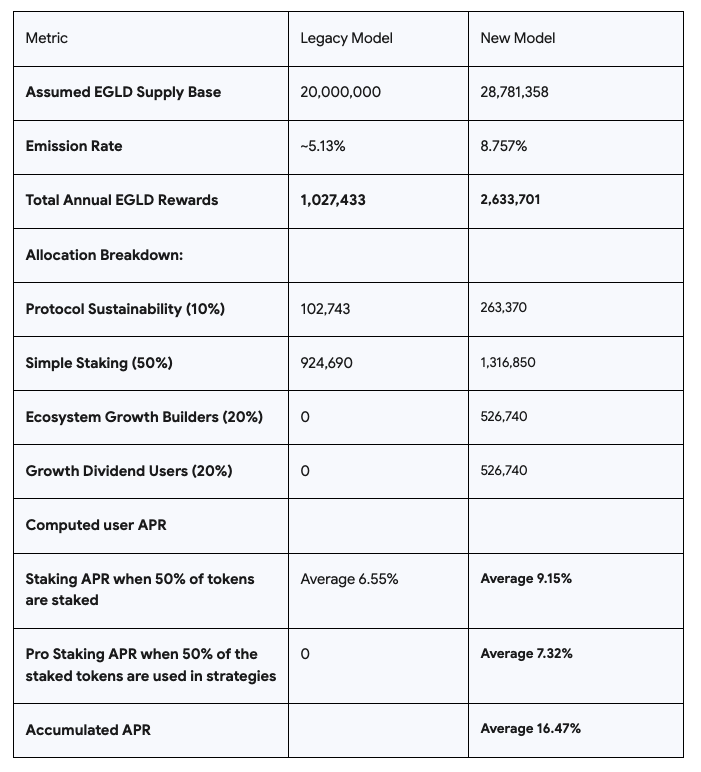
At the current moment, ~1.8m EGLD (about 12.5% of the total EGLD staked) are participating in productive yield strategies via liquid staking to generate economic activity and value for the protocol. Through the Active Yield Growth Dividend, we are aiming to channel up to 50% of the total staked EGLD into such productive strategies, boosting TVL and driving transaction volume.
The boosted strategies provided by expert DAOs and chosen by the users can range from low-risk options with lower additional rewards to higher-risk and reward strategies with extra protocol incentives.
The Economic Flywheel: How LSTs and DeFi Drive EGLD Value
The Growth Dividend is designed to transform staking from a passive activity into a driver of network-wide economic expansion. At its core, liquid staking tokens (LSTs) compound two effects: they secure the network by locking EGLD while simultaneously keeping capital productive in DeFi.
By pairing staked EGLD (via LSTs) with external assets such as USDC or wBTC, users inject new liquidity into the ecosystem. This creates the foundation for deeper markets and more resilient DeFi infrastructure.
-
More Liquidity → More DeFi: Builders can design advanced products and strategies when liquidity is abundant and reliable.
-
More DeFi → More Opportunities: A richer landscape attracts arbitrage, trading, and innovative use cases.
-
More Opportunities → More Transactions: Onchain activity accelerates as users, bots, and protocols engage with these markets.
-
More Transactions → More Revenue & Scarcity: Every action generates fees for builders and the protocol while the burn mechanism ensures each transaction makes EGLD more scarce, creating a direct feedback loop where usage itself is the engine of value
In short, protocol emissions are no longer a passive subsidy but are instead precisely targeted capital injections, designed to bootstrap a perpetual cycle of liquidity, utility, and transaction growth—ensuring that the network’s emissions are constantly being met by an even greater, protocol-driven demand.
D. Influences from Leading Economists on Growth and Innovation in Crypto Networks
This paper draws conceptual inspiration from prominent economists who advocate prioritizing economic growth over strict inflation control, particularly by channeling resources (e.g., via stimulus or expansion) toward innovation and productivity. Here is a list of authors and books.
-
Paul Krugman (Nobel Prize, 2008): Argues in End This Depression Now! for using emissions for productive recovery and growth, which parallels crypto networks funding development despite short-term price pressures.
-
Mark Blyth: Critiques austerity in Austerity: The History of a Dangerous Idea, advocating instead for expansionary policies to invest in growth, a concept similar to avoiding artificial scarcity in crypto through productive token issuance.
-
Edmund S. Phelps (Nobel Prize, 2006): Emphasizes in Mass Flourishing that grassroots innovation is the core of economic growth, justifying inflation when it fuels entrepreneurship, as seen in crypto grants and builder rewards.
-
Tyler Cowen: Posits in Stubborn Attachments that maximizing long-term, compounding growth is a moral priority, a principle that applies to creating sustainable, innovation-focused economic models in crypto.
(!) Disclaimer: This document is not investment advice. It is intended solely to describe protocol-level mechanics under the applicable legal regulations.